Distributed urban drag parametrization for sub‐kilometre scale numerical weather prediction
Birgit S. Sützl, Gabriel G. Rooney, Anke Finnenkoetter, Sylvia I. Bohnenstengel, Sue Grimmond, Maarten van Reeuwijk
Quarterly Journal of the Royal Meteorological Society · 2021
Abstract
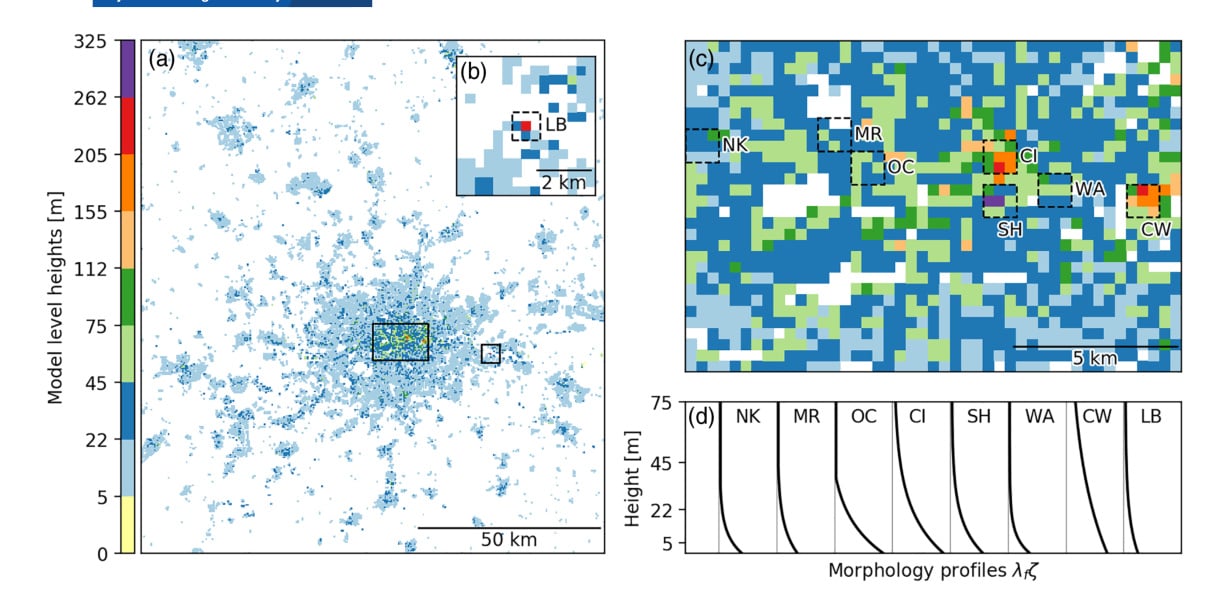
A recently developed, height-distributed urban drag parametrization is tested with the London Model, a sub-kilometre resolution version of the Met Office Unified Model over Greater London. The distributed-drag parametriza- tion requires vertical morphology profiles in the form of height-distributed frontal-area functions, which capture the full extent and variability of build- ing heights. London’s morphology profiles are calculated and parametrized by an exponential distribution with the ratio of maximum to mean building height as the parameter. A case study evaluates the differences between the new distributed-drag scheme and the current London Model setup using the MORUSES urban land-surface model. The new drag parametrization shows increasedhorizontalspatialvariabilityintotalsurfacestress,identifyingdensely built-up areas, high-rise building clusters, parks, and the river. Effects on the windspeedinthelowerlevelsincludealessergradientandmoreheterogeneous windprofiles,extendedwakesdownwindofthecitycentre,andverticallygrow- ing perturbations that suggest the formation of internal boundary layers. The surfacesensibleheatfluxesareunderpredicted,whichisattributedtodifficul- tiescouplingthedistributedmomentumexchangewiththesurface-basedheat exchange.
Funding
- EP/L016613/1