Parameter investigation for urban surface‐energy balance: A large‐eddy simulation study
Christopher E. Wilson, Jonathan K. P. Shonk, Sylvia I. Bohnenstengel, Athanasios Paschalis, Maarten van Reeuwijk
Quarterly Journal of the Royal Meteorological Society · 2026
Abstract
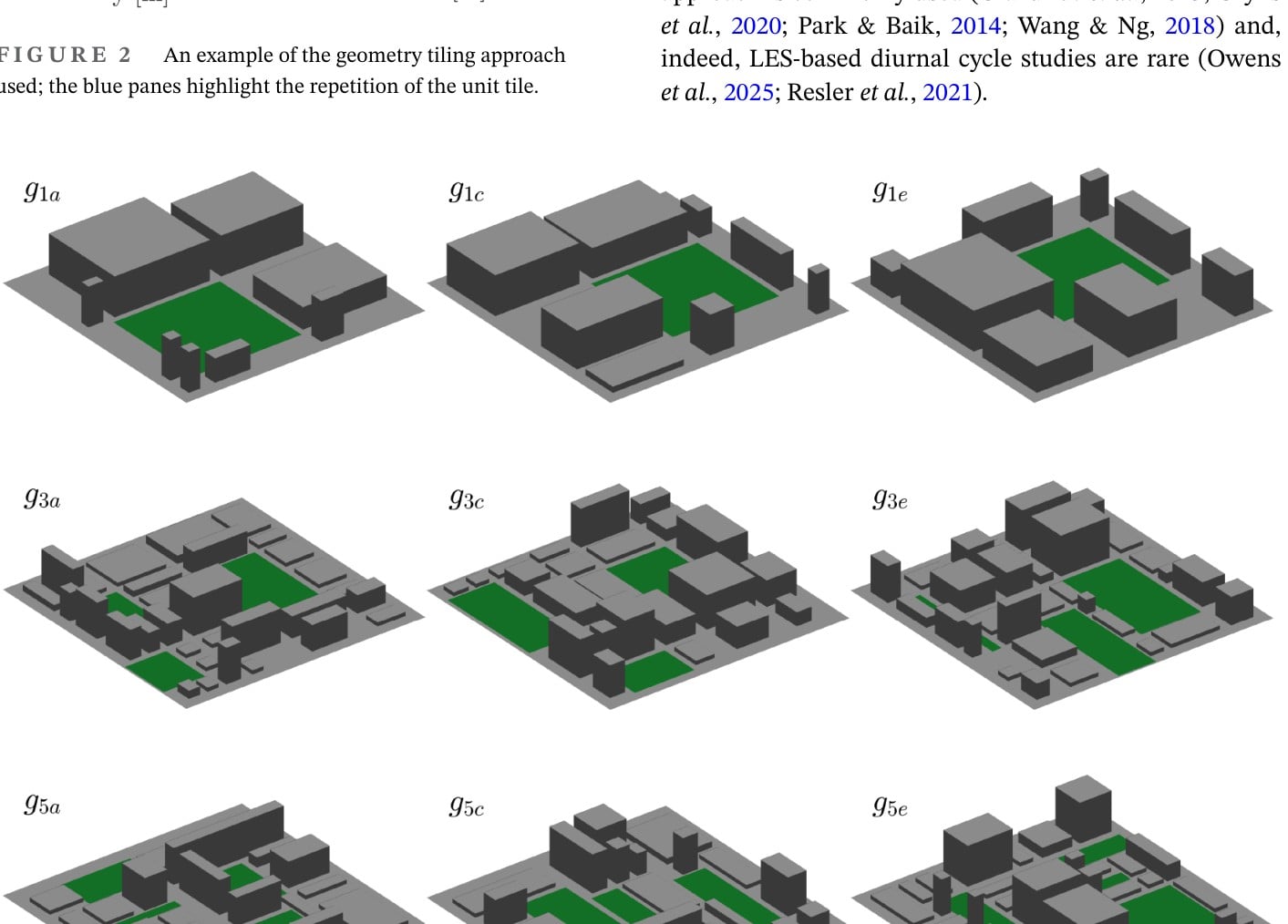
This work investigates the impact of microscale surface variability on the surface-energy balance (SEB) in vegetated urban areas, evaluates the suit- ability of several commonly used morphological variables (𝜆p, 𝜆v,a n d𝜆f)i n terms of their ability to parameterise the SEB, and investigates a set of alter- native parameters. This is done by performing large-eddy simulations for an ensembleofrandomlygeneratedurbangeometries(producedusingalandscape generator) and comparing the results. The geometries would be considered identical by most numerical weather prediction (NWP) land-surface models (LSMs), but are uniquely different when resolved at the microscale. We find that variations in the SEB fluxes are relatively small, suggesting that assump- tions made by existing LSMs are valid—namely that𝜆 p, 𝜆v,a n d𝜆f alone do give a reasonable parameterisation of the urban surface from a mesoscale perspective. Using Gaussian-process-based machine learning to enable formal sensitivity analysis, we find that the maximum building height is important in determining all of the fluxes, with the exception of the latent heat flux, which depends predominantly on the fraction of shaded green space. The average building height and albedo of sunlit surfaces are also found to be of importance.
Funding
- NE/W002868/1
Related projects
- ASSURE: Across-Scale processeS in URban Environments NE/W002868/1