Evaluation of an operational air quality model using large-eddy simulation
Tom Grylls, Clémence M.A. Le Cornec, Pietro Salizzoni, Lionel Soulhac, Marc E.J. Stettler, Maarten van Reeuwijk
Atmospheric Environment: X · 2019
Abstract
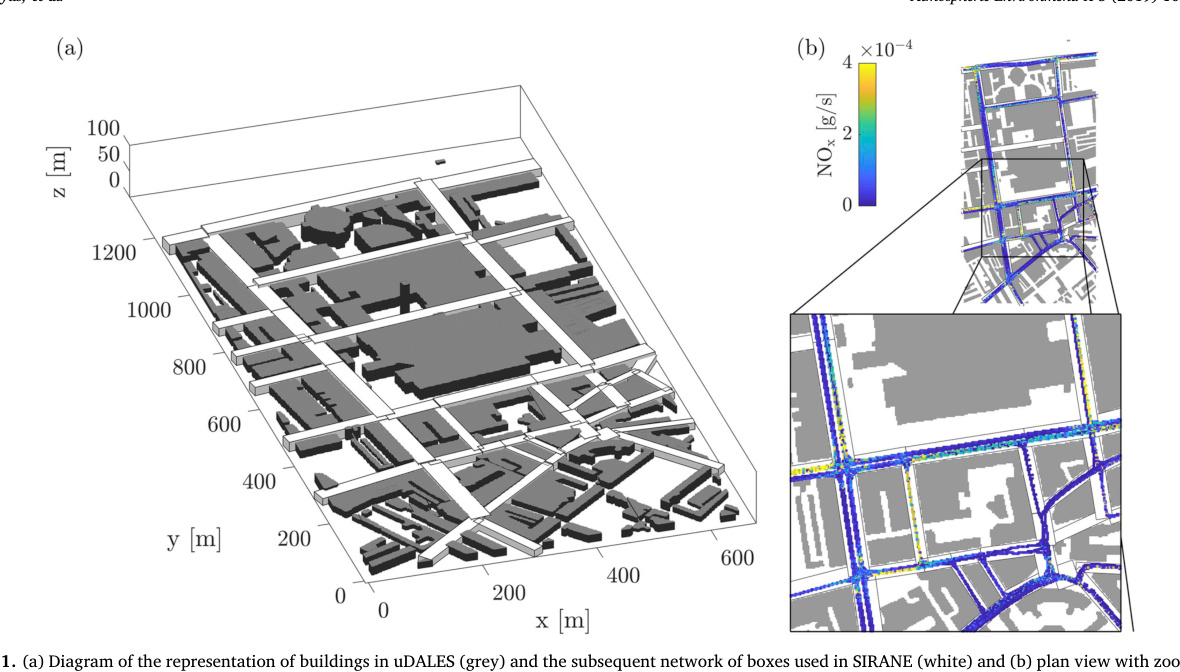
The large-eddy simulation (LES) model uDALES is used to evaluate the predictive skill of the operational air quality model SIRANE. The use of LES in this study presents a novel approach to air quality model evaluation, avoiding sources of uncertainty and providing numerical control that permits systematic analysis of targeted parametrisations and assumptions. A case study is conducted over South Kensington, London with the morphology, emissions, meteorological conditions and boundary conditions carefully matched in both models. The dispersion of both inert (NO x) and reactive (NO, NO2 and O3) pollutants under neutral, steady-state conditions is simulated for a south-westerly and westerly wind direction. A quantitative comparison between the two models is performed using statistical in- dices (the fractional bias, FB, the normalised mean squared error, NMSE, and the fraction in a factor of 2, FAC2). SIRANE is shown to successfully capture the dominant trends with respect to canyon-averaged concentrations of inert NO x(FB = −0.08, NMSE = 0.08 and FAC2 = 1.0). The prediction of along-canyon velocities is shown to exhibit sources of systematic error dependant on the angle of incidence of the mean wind (FB = −0.18). The assumption of photostationarity within SIRANE (deviations from equilibrium of up to 170% exist close to busy roads) is also identified as a significant source of systematic bias resulting in over- and underpredictions of NO 2 (FB = −0.18) and O3 (FB = 0.14) respectively. The validity of the assumed uniform in-canyon concentration is assessed by analysing the pedestrian, leeward and windward concentrations resolved in uDALES. The use of canyon-averaged concentrations to predict pedestrian level exposure is shown to result in significant under- estimations. Linear regression is used to effectively capture the relationship between pedestrian- and canyon- averaged concentrations in uDALES. Correction factors are derived ( m 1.62 and =R 0.922 for inert NOx) th
Funding
- EP/L016826/1