Urban air quality: What is the optimal place to reduce transport emissions?
Tianyang Li, Sofia Fellini, Maarten van Reeuwijk
Atmospheric Environment · 2023
Abstract
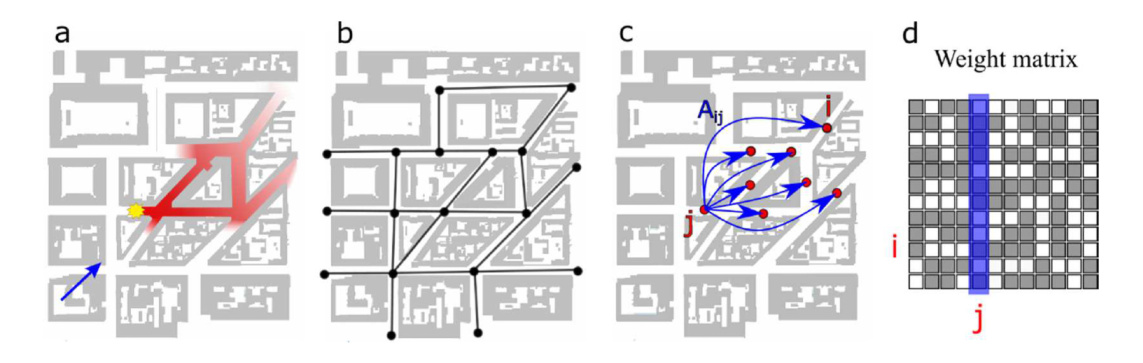
We develop a linear model based on a complex network approach that predicts the effect of emission changes on air pollution exposure in urban street networks including NO – NO 2 – O 3 -chemisty. The operational air quality model SIRANE is used to create a weighted adjacency matrix A describing the relation between emissions of a passive scalar inside streets and the resulting concentrations in the street network. A case study in South Kensington (London) is used, and the adjacency matrix A 0 is determined for one wind speed and eight different wind directions. The physics of the underlying problem is used to infer A for different wind speeds. Good agreement between SIRANE predictions and the model is observed for all but the lowest wind speed, despite non-linearities in SIRANE ’ s model formulation. An indicator for exposure in the street is developed, and it is shown that the out-degree of the exposure matrix E represents the effect of a change in emissions on the exposure reduction in all streets in the network. The approach is then extended to NO – NO 2 – O 3 -chemisty, which introduces a non-linearity. It is shown that a linearised model agrees well with the fully nonlinear SIRANE predictions. The model shows that roads with large height-to-width ratios are the first in which emissions should be reduced in order to maximise exposure reduction.