Microscale to neighbourhood scale: Impact of shading on urban climate
Christopher Wilson, Jonathan K.P. Shonk, Sylvia I. Bohnenstengel, Athanasios Paschalis, Maarten van Reeuwijk
Building and Environment · 2025
Abstract
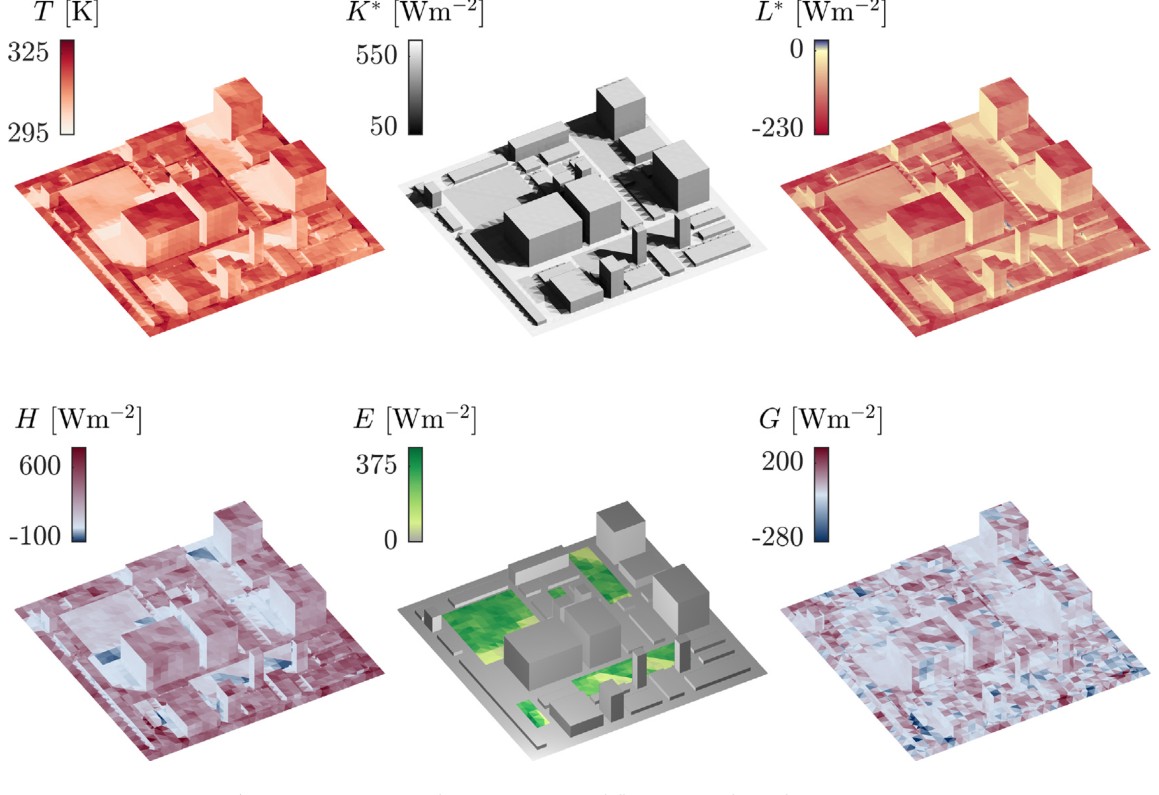
This work investigates the impact that the distribution of shading has on the urban surface energy balance (SEB) and microclimate. We use the building-resolving large eddy simulation code uDALES to perform simulations of a realistic vegetated urban area, consistent with a mixed-type commercial and residential land use zone, under convective atmospheric conditions. Two cases are considered, one with a solar zenith angle of 𝑍 = 0 ◦ (the Sun directly overhead) and the other with 𝑍 = 45 ◦ (mid-morning). The incoming solar radiation is chosen such that the total power is the same in both cases in order to isolate the effects of the shading distribution. We find that microclimate scale variations in the surface energy balance (SEB) and mean radiant temperature (MRT) depend most significantly on whether or not a region is in direct sunlight. For example, on average the net shortwave radiation and sensible heat flux differ by approximately 424 Wm−2 and 277 Wm−2 respectively when comparing between shaded and unshaded surfaces. However, averaged across the domain, the distribution of shading does not impact the SEB fluxes, except for the latent heat flux ( 𝐸) which is 22% higher when 𝑍 = 0 ◦. Similarly, the average MRT varies little between the two cases — differing by 0.19 K. Radiation emitted and reflected from the surface is found to dominate the MRT. This work illustrates the impact that shading distribution has on the microclimate highlighting the importance of resolving the urban surface explicitly.