The drag length is key to quantifying tree canopy drag
Dipanjan Majumdar, Giulio Vita, Rubina Ramponi, Nina Glover, Maarten van Reeuwijk
Journal of Wind Engineering and Industrial Aerodynamics · 2025
Abstract
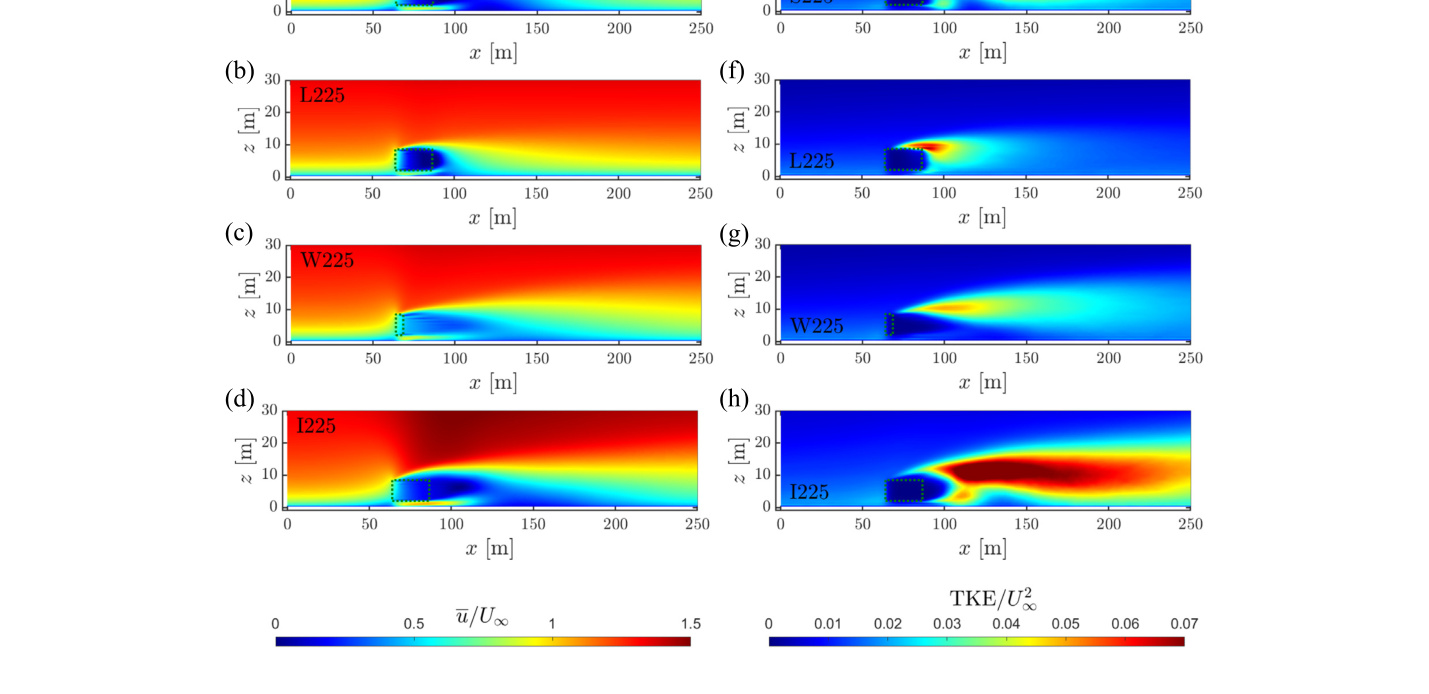
The effects of trees on urban flows are often determined in computational fluid dynamics simulations using a quadratic drag formulation based on the leaf-area density 𝑎 and a volumetric drag coefficient 𝐶 𝑉 𝑑 . We develop an analytical model for the flow within a vegetation canopy and identify the drag length 𝓁𝑑 = (𝑎𝐶 𝑉 𝑑 )−1 as the key metric to describe the local tree drag, which represents the adjustment lengthscale for the mean velocity inside the canopy due to tree drag. A detailed literature survey suggests that the median 𝓁𝑑 observed in field experiments is 21 m for trees and 0.7 m for low vegetation (crops). Total 168 large-eddy simulations are conducted to obtain a closed form of the analytical model which allows determining 𝑎 and 𝐶 𝑉 𝑑 from the wind-tunnel experiments that typically present the drag characteristics in terms of the classical drag coefficient 𝐶𝑑 and the aerodynamic porosity 𝛼𝐿. We show that geometric scaling of 𝓁𝑑 is the appropriate scaling of trees in wind tunnels. Evaluation of 𝓁𝑑 for numerical simulations and wind-tunnel experiments (assuming geometric scaling 1 ∶ 100 ) in literature shows that the median 𝓁𝑑 in both these cases is about 5 m, suggesting a potential overestimation of vegetative drag.
Funding
- EP/W026686/1