Nowcasting street-level NO₂ concentrations using Gaussian processes
Matteo Schoucair, Maarten van Reeuwijk
Science of The Total Environment · 2025
Abstract
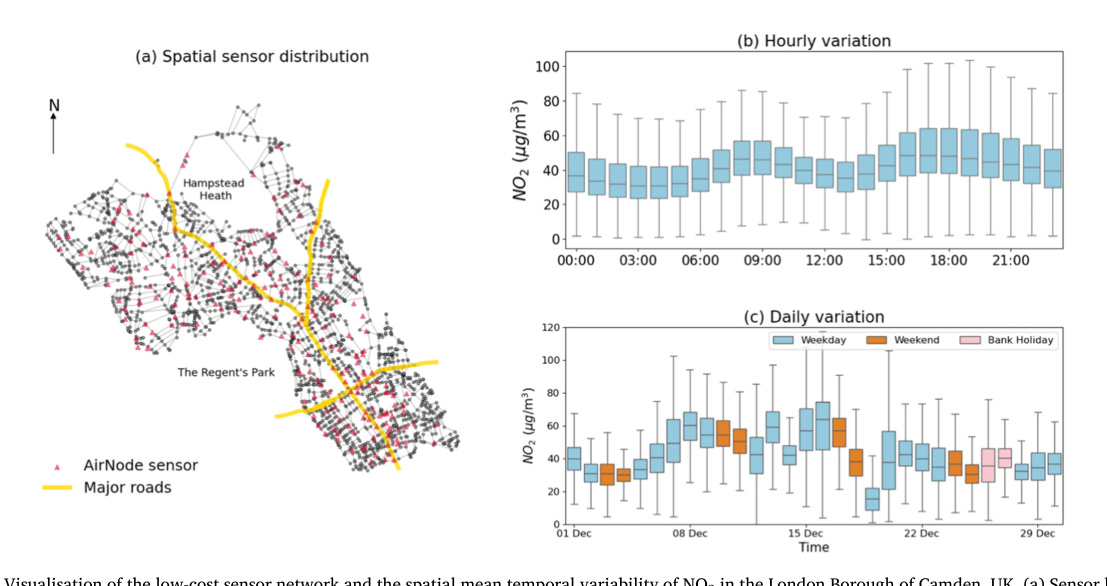
Gaussian Processes (GPs) are used to develop a nowcasting model for street-level NO 2 concentration in the Borough of Camden, UK, using the data from a dense network of 225 low-cost air quality sensors. This study aims to leverage these data to predict the distribution of NO 2 across the entire street network . A comprehensive set of features is considered for every street that includes the street geometry (width, height, length), road network metrics (betweenness and degree centrality), coordinates (latitude and longitude) and the road classification. A global sensitivity analysis reveals that the three most important features required for NO 2 prediction with GPs are, in order of importance, the street width, betweenness centrality, and road length. These three features alone explain 81 % of the variance in the system (excluding external interactions). A GP model based on these three features accurately nowcasts NO 2 concentrations with an average median absolute error of 7.31 μ g / m 3 during the month of December 2022 for measurements sampled every 30 min. For each street, the model also provides an associated standard deviation, quantifying the uncertainty of the predictions. We find that across the entire network, 70.3 % of the streets exhibit a standard deviation below the mean predictive uncertainty σ X * , offering a robust and scalable framework for NO 2 predictions across large and complex urban networks.