Structure and scaling of inclined temporal gravity currents
Lianzheng Cui, Graham O. Hughes, Maarten van Reeuwijk
Journal of Fluid Mechanics · 2025
Abstract
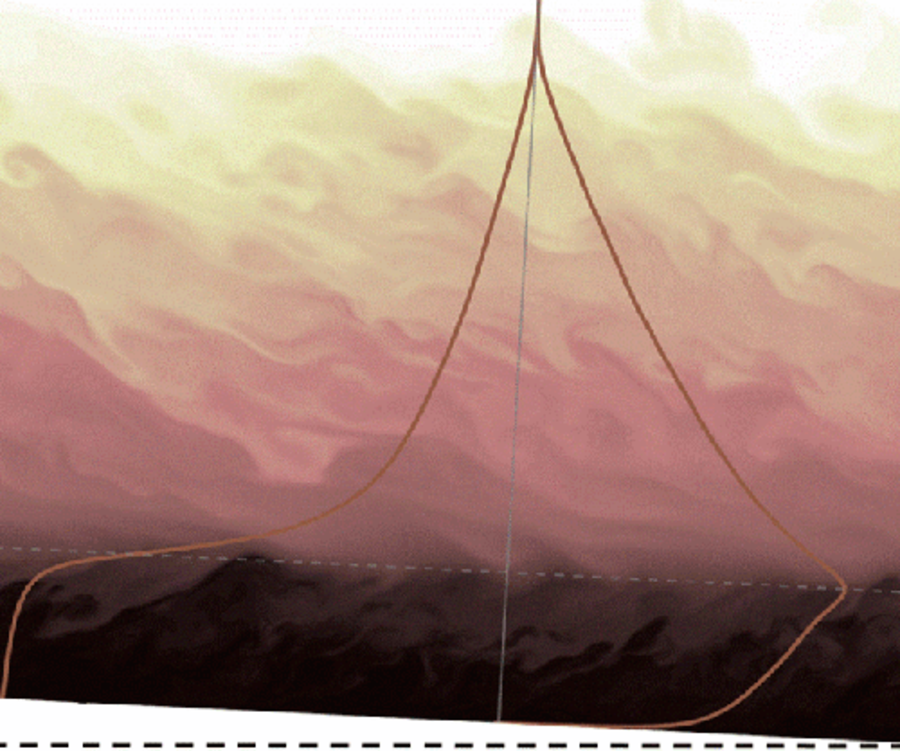
We explore the fundamental flow structure of temporally evolving inclined gravity currents with direct numerical simulations. A velocity maximum naturally divides the current into inner and outer shear layers, which are weakly coupled by momentum and buoyancy exchanges on time scales that are much longer than the typical time scale characterising either layer. The outer layer evolves to a self-similar state and can be described by theory developed for a current on a free-slip slope (Van Reeuwijk et al. 2019, J. Fluid Mech., vol. 873, pp. 786–815) when expressed in terms of outer-layer properties. The inner layer evolves to a quasi-steady state and is essentially unstratified for shallow slopes, with flow statistics that are virtually indistinguishable from fully developed open channel flow. We present the classic buoyancy–drag force balance proposed by Ellison & Turner (1959, J. Fluid Mech., vol. 6, pp. 423–448) for each layer, and find that buoyancy forces in the outer layer balance entrainment drag, while buoyancy forces in the inner layer balance wall friction drag. Using scaling laws within each layer and a matching condition at the velocity maximum, the entire flow system can be solved as a function of the slope angle, in good agreement with the simulation data. We further derive an entrainment law from the solution, which exhibits relatively high accuracy across a wide range of Richardson numbers, and provides new insights into the long runout of oceanographic gravity currents on mild slopes.
Funding
- EP/R029326/1
- EP/X035484/1
- EP/V033883/1
Related projects
- The UK Turbulence Consortium EP/X035484/1
- UK Turbulence Consortium EP/R029326/1