Orbitally shaken shallow fluid layers. I. Regime classification
Paola Alpresa, Spencer Sherwin, Peter Weinberg, Maarten van Reeuwijk
Physics of Fluids · 2018
Abstract
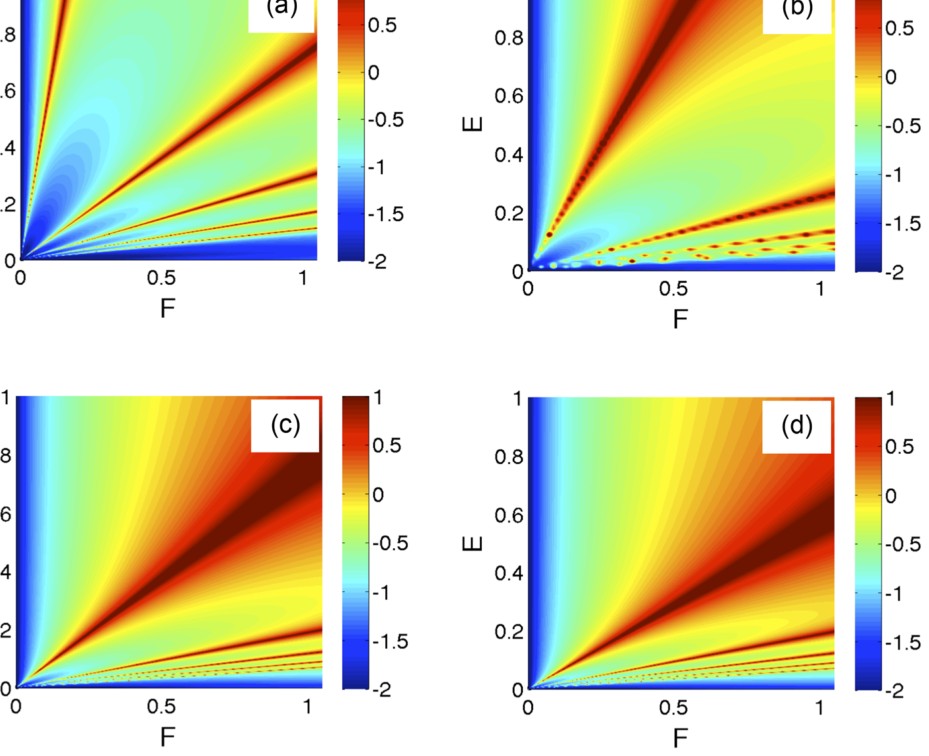
Orbital shakers are simple devices that provide mixing, aeration, and shear stress at multiple scales and high throughput. For this reason, they are extensively used in a wide range of applications from protein production to bacterial biofilms and endothelial cell experiments. This study focuses on the behaviour of orbitally shaken shallow fluid layers in cylindrical containers. In order to investigate the behaviour over a wide range of different conditions, a significant number of numerical simulations are carried out under different configuration parameters. We demonstrate that potential theory—despite the relatively low Reynolds number of the system—describes the free-surface amplitude well and the velocity field reasonably well, except when the forcing frequency is close to a natural frequency and resonance occurs. By classifying the simulations into non-breaking, breaking, and breaking with part of the bottom uncovered, it is shown that the onset of wave breaking is well described by ∆h/(2R) = 0.7Γ, where ∆h is the free-surface amplitude, R is the container radius, and Γ is the container aspect ratio; ∆h can be well approximated using the potential theory. This result is in agreement with standard wave breaking theories although the significant inertial forcing causes wave breaking at lower amplitudes. Published by AIP Publishing. https://doi.org/10.1063/1.4996916