A Lagrangian Study of Interfaces at the Edges of Cumulus Clouds
Vishnu Nair, Thijs Heus, Maarten van Reeuwijk
Journal of the Atmospheric Sciences · 2021
Abstract
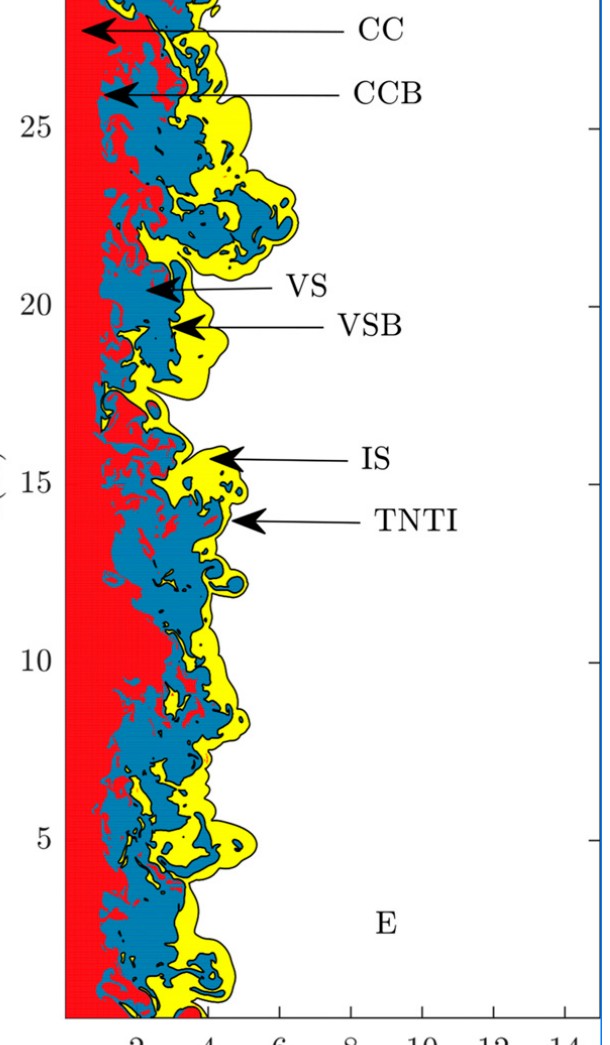
Interfaces at the edge of an idealized, nonprecipitating, warm cloud are studied using direct numerical simulation (DNS) complemented with a Lagrangian particle tracking routine. Once a shell has formed, four zones can be distinguished: the cloud core, visible shell, invisible shell, and the environment. The union of the visible and invisible regions is the shell common ly referred to in literature. The boundary between the invisible shell and the environment is the turbulent–nonturbulent interface (TNT I), which is typically not considered in cloud studies. Three million particles were seeded homogeneously across the d omain and properties were rec orded along individual tra- jectories. The results demonstrate tha t the traditional cloud boundary (separ ating cloudy and noncloudy regions using thresholds applied on liquid condensate or updraft velocit y) are some distance away from the TNTI. Furthermore, there is no dynamic difference between the traditional liquid-condensate boundary and the region extending to the TNTI. However, particles crossing the TNTI exhibit a s harp jump in enstrophy and a smooth increase in buoyancy. The traditional cloud boundary coincides with the location of minimum buoyancy in the shell. The shell premixes the entraining and detraining air and analysis reveals a hig hly skewed picture of entrai nment and detrainment at the traditional cloud boundary. A preferential entrainment of p articles with velocity and specific humidity higher than the mean values in the shell is observed. Large-eddy simu lation of a more realistic setup detects an interface with similar properties using the same thresholds as in the DNS, i ndicating that the DNS results extrapolate beyond their idealized conditions.
Funding
- EP/R029326/1
Related projects
- UK Turbulence Consortium EP/R029326/1